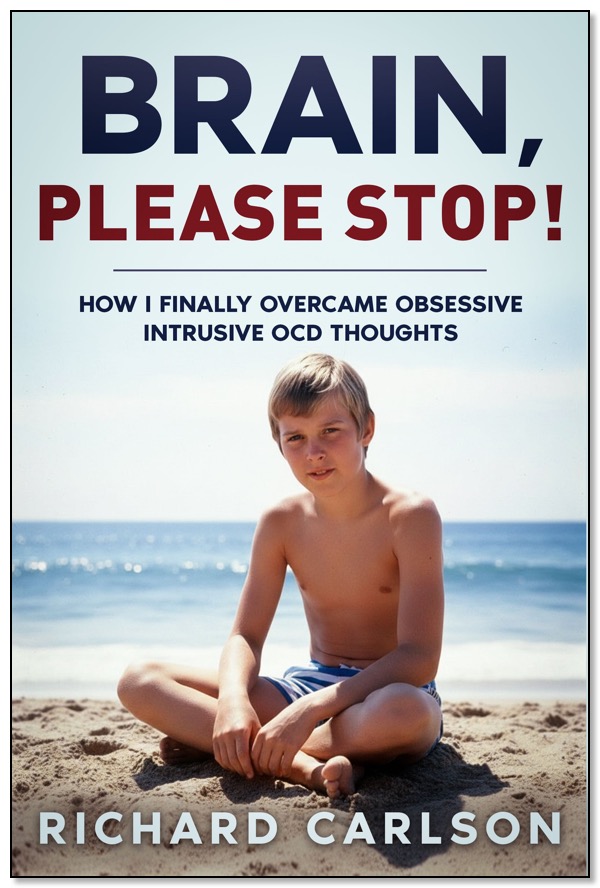
Brain, Please Stop! - Free e-Book
 .
.
"I’d much rather rid myself of most of these awful distracting thoughts than win a billion dollars in the lottery! How did I do it?…" - Rich Carlson
Coming Very Soon!
CLICK HERE NOW to IMMEDIATELY Download the "Brain, Please Stop!" e-Book for ABSOLUTELY FREE!

What is Obsessive Compulsive Disorder (OCD)
Obsessive compulsive disorder (OCD) can plague people in a variety of ways affecting their thinking and actions.
OCD – Three important factors:
Obsession – undesired, intrusive and many times disturbing thinking, picture in mind’s eye or vibe over and over again fills the patient’s brain.
Feelings - the obsession creates exhaustive stress
Compulsions – doing things or thinking things the person feels he must absolutely do because of the exhaustive stress resulting from the obsession.
The behavior briefly makes the exhaustive stress go away. The obsession and stress come back quickly making the behavior repeat.
Patients with OCD have obsessions and compulsions, and either might be not as recognized by the person.
Obsessive Thinking
Probably everyone experiences disturbing ideas in their mind at times, such as they didn’t remember to turn a light switch off, or think about not wanted cruel or horrible pictures in their mind’s eye.
If you experience continual, unwanted thinking that overwhelms your mind, intruding other thinking you might suffer from an obsession.
Possible Obsessions:
Being afraid of hurting people including the patient by him or herself. A patient might have a fear of injuring another person or animal, such as their pet dog or cat.
Being afraid of hurting others or self unintentionally. A patient might be afraid a child might cut themselves because you left a sharp knife out.
Being afraid of getting an ailment, or some other undesired material
An overwhelming desire for arranging things. The patient can have the urge to make all the cans of food in a pantry face outward perfectly straight.
The patient can experience thinking of a hurtful or physical violations that the patient feels are abhorrent or terrifying. Experiencing thinking of this nature does not indicate the patient will do them.
Thinking as stated are considered OCD when they make the patient feel mental anguish and negatively affect their functioning.
Compulsive Actions
Compulsive behavior is how OCD patients can lesson or eliminate the intense stress as a result of obsessive thinking, but these actions are too much or not rationally linked.
For example, a patient who fears not being polite, may disinfect a toilet seat every time after using it over and over again to satisfy their thinking.
Many patients who have OCD know that their actions are reasonless, but the patient must continue and cannot halt the action and believe they must because there’s a chance it’s necessary.
Compulsive actions of many OCD patients:
• washing and cleaning
• confirming – for example, confirming that the water was turned off
• tallying
• placing things in a certain place
• saving things to an extreme
• questioning others to confirm things
• saying things over and over again in their mind
• equalizing thinking to overcome obsessive actions
• not going to areas and avoiding occurrences that can cause obsessive thinking
Some compulsive actions will not be apparent to others.
Being afraid of hurting people including the patient by him or herself. A patient might have a fear of injuring another person or animal, such as their pet dog or cat.
Being afraid of hurting others or self unintentionally. A patient might be afraid a child might cut themselves because you left a sharp knife out.
Being afraid of getting an ailment, or some other undesired material
An overwhelming desire for arranging things. The patient can have the urge to make all the cans of food in a pantry face outward perfectly straight.
Reference:
“Symptoms - Obsessive Compulsive Disorder (OCD).” NHS choices. Accessed April 19, 2026. https://www.nhs.uk/mental-health/conditions/obsessive-compulsive-disorder-ocd/symptoms/. 